


After we consistently predicted that Congress could not write and pass a new transportation law before the September 30 expiration of the Infrastructure Investment and Jobs Act (IIJA), Congress has finally thrown in the towel and is moving to extend the IIJA before that deadline. What is an extension, how long should it be, and what should it include?
After we were lightly ridiculed inside and outside of the Capitol for consistently predicting that Congress was never going to get a new bill finished this year, you can nail that coffin shut on 2026 reauthorization: It’s not happening in this Congress. The House’s (bad) BUILD America 250 Act (we call it the BUILD Act) is not scheduled for a floor vote anytime soon, but even if a miracle occurred, the Senate is already working on an extension and would not consider it. Senator Shelly Moore Capito, who chairs the core Senate committee with jurisdiction, has already told reporters that the committee is working on text to extend the IIJA.
While it’s nice to (once again) be right, we can now ask: What will we see in that extension, and how long should it be? And most importantly, why should Congress keep passing extensions for the foreseeable future and refuse to negotiate on reauthorization?
Why and what is an extension?
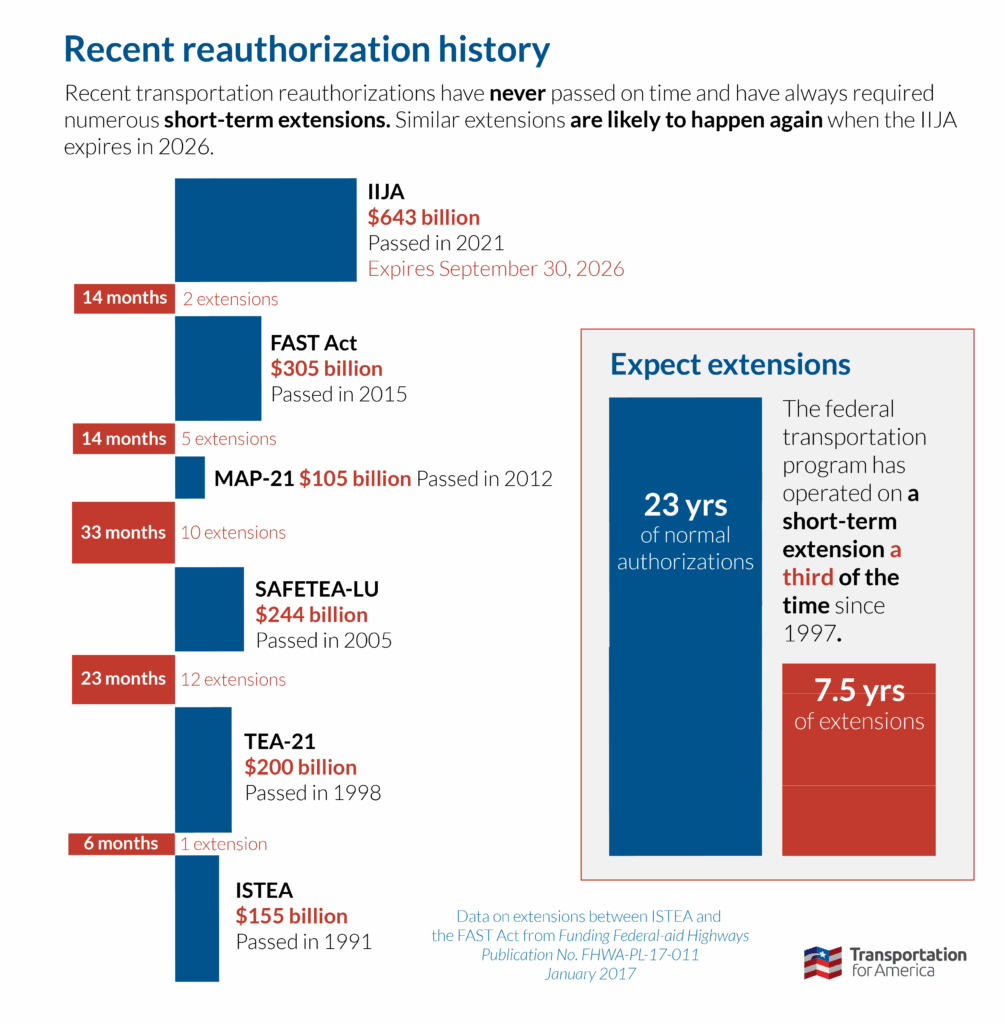
One of the reasons we were so confident that Congress would never pass something before this year’s deadline was that doing so would have been completely unprecedented. They’ve simply never done it before! Extensions have happened every single time a reauthorization is facing an expiration in the modern era. Our Reauthorization 101 guide shows that the federal program has been operating on an extension literally a third of the time since 1997!
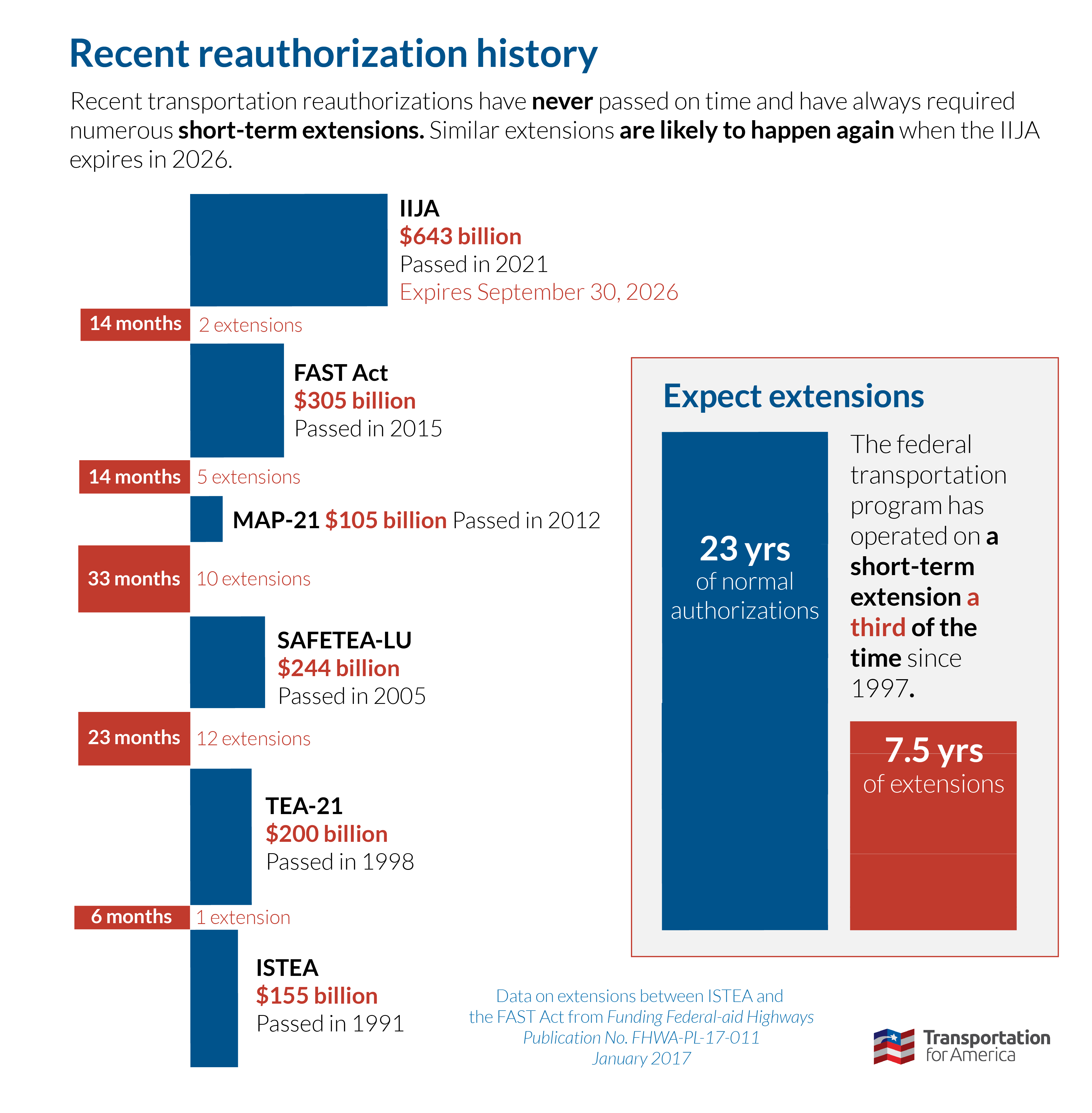
Originally due to expire in 2009, SAFETEA-LU was extended a mind-boggling TEN times for 33 total months before MAP-21 was passed to replace it in 2012. It’s notable that the same core issue Congress was stuck on back then—how to pay for a bankrupt transportation program that spends way more money than the gas tax brings in—is the same fundamental sticking point today.
The reason for these past extensions is the same reason as today: To buy more time for negotiations and policy development because Congress couldn’t get the job done in the time allotted. But in this case, the issue will be punted to a new Congress in January.
The historical precedent is a “clean” extension
This is a phrase you’ve probably heard already. All this means is continuing existing programs at current year funding levels, with no major changes to the policy that Congress approved back in 2021 with the IIJA. No new major programs are created, nor are any existing programs repealed. Funding-wise, it’s basically a bonus year of IIJA, although with funding levels typically remaining at the same level as this current fiscal year, rather than increasing as they ordinarily do during each successive year of a long-term law.
The only major changes included in past extensions have been financing-related steps to transfer money into the Highway Trust Fund to keep it solvent for the life of the extension, which is almost certainly needed in this case.
There should be one exception to this precedent: Congress should include language that requires USDOT to restore rescinded grants and fully implement the programs and funding that they wrote into law in the IIJA. There’s a good chance that USDOT will just ignore any requirements Congress chooses to insert, just like they’ve already done with the IIJA. This is just more proof that Congress needs to force this issue and start complaining loudly and publicly about the ways the administration has undermined the bipartisan will of Congress.
A new wrinkle in 2026: Advance appropriations
One complicating factor that did not exist in past extension cycles is the novel mechanism Congress used in the IIJA called “advance appropriations.” This was a way for Congress to provide more money that would automatically become available in the future fiscal years of the IIJA, without requiring further action by Congress in annual appropriations bills. One example of this is the transit capital grants program that funds new transit. (Yes, the same one currently frozen by the Trump admin, which was covered this week by the New York Times.) In the past, this program would have funds “authorized” for it over the life of the five-year authorization law, but Congress’ appropriations committees would have to debate and approve money for that program each year. But in the IIJA, around a third of the total funding for transit capital grants was provided by guaranteed advance appropriations. Two-thirds of the historic $66 billion for passenger rail was also provided by this method.
Extending the program for a year while potentially providing additional advance appropriations is definitely more complex than in the past, though it’s also still just another form of deficit spending, which is going to be required no matter what.
What now? Pass a one-year clean extension
When Congress is chugging along in the reauthorization process, with proposals moving through both chambers, shorter extensions could make sense to keep the pressure up and provide just enough time. But with just one chamber having passed a bill they should honestly scrap and forget about (The BUILD Act) and with an election looming just 33 days after expiration, that is not the context for this Congress. While many members will return, reauthorization will ultimately be handed over to the 120th Congress, which will include scores of newly elected members.
A year is the most prudent length to give the next Congress so that they have enough time to get seated and start their work, which will not get going immediately in 2027 as members will face a range of competing issues. A six-month extension would expire in March, giving them a ticking clock and almost certainly requiring another extension anyway.
Make it a year.
Forget about reauthorization—Congress should keep passing extensions
Yes, you read that right.
There is no deal to be made on a new long-term surface transportation reauthorization as long as this administration is failing to follow the existing law. Congress should keep passing one-year extensions of the IIJA until they see faithful implementation of the law by the administration and USDOT.
The administration is disrespecting both the intent of Congress’s bipartisan action on the IIJA as well as the American people and their local communities getting jerked around by USDOT’s unprecedented action to withhold or rescind funding for grant programs, delay (possibly indefinitely) all transit Capital Investment Grants, reinterpret grant-funding criteria, and weaponize programs like the Safe Streets for All program. Congress passes the laws; the executive branch implements them. USDOT is not, nor should it be, above that respect.
Faithful implementation of IIJA would mean ensuring that authorized programs, competitive grant processes, and statutory requirements are administered according to the law and without unauthorized delay, reinterpretation, substitution, or withholding.
We find it baffling that Congress—especially the Democrats and those leading the negotiations in the House and Senate—would choose to strike any deal to give this administration additional money when the same people are telling you loudly and publicly that they will not honor the full scope of whatever bipartisan deal you reach.
Until Congress sees the full and faithful implementation of the IIJA, they should stay away from the negotiating table and keep extending the law one year at a time until there is an administration that can be trusted to implement the law as written.
The post Extend the IIJA for one more year—and potentially more appeared first on Transportation For America.
