
Traffic congestion is universally hated. It’s headache-inducing, reduces productivity, and wastes gas. That makes it easy for political leaders to say they’re against it and campaign on fixing it. But decades of building more lanes and increasing roadway capacity have only made the problem worse. So why do leaders keep supporting more of the same?
Congestion is easy to hate and easy to support
Traffic congestion is a phenomenon that all roadway users have inescapably experienced. While sitting in bumper-to-bumper traffic, idle cars still burn fuel, with most drivers burning 0.16 gallons an hour just idling. Traffic congestion can also have negative economic impacts. A 2025 report found that the average U.S. driver lost 49 hours to traffic congestion that year. That’s 49 hours that could have been spent with family and friends, recuperating from a long workday, or enjoying hobbies. Traffic congestion can even harm public health and increase mortality rates from vehicle emissions that hit communities near major roadways hardest.
It’s easy to argue that congestion is a blight on society, harming communities, economies, and individuals. But how should congestion be addressed?
For decades, the default solution has been to build more roadway capacity. The numbers show how well that has worked. From 1993 to 2017, the U.S. increased freeway lane miles by 42 percent, significantly outpacing the 32 percent population growth. But over that same period, congestion increased by 144 percent. That’s largely because these projects encourage people to drive more, demonstrated by the 57 percent increase in vehicle-miles traveled (VMT) during that same timeframe.
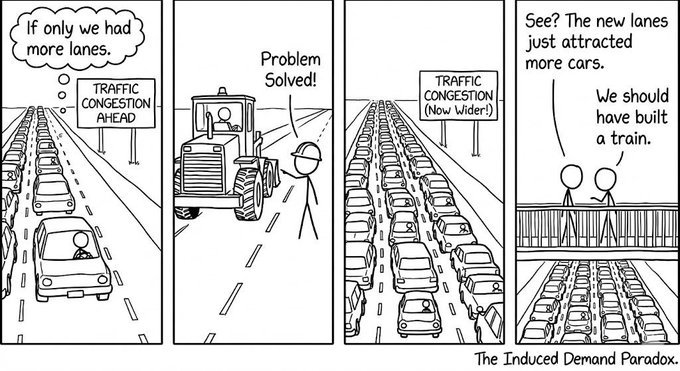
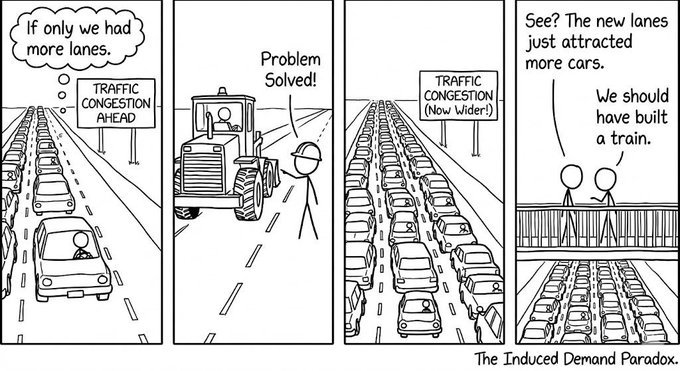
That’s the paradox of induced demand, the phenomenon in which expanding roadways to improve traffic flow actually increases congestion because they encourage people to drive more than they otherwise would. That means that over time, adding one more lane encourages more driving, eventually eating away at the congestion relief it was supposed to provide. Given the way state DOTs act, you would think the opposite is true.
Sprawling development is another factor in worsening congestion. Greater distances between home, work, and other places lead to more car trips and longer trips, increasing congestion. If your home, grocery store, and children’s school are all three miles apart with poor transit options, you have no choice but to make multiple short trips by car.
Our fixation on congestion can even make it harder to build housing in the places where people could drive less. New housing in already-developed communities is often evaluated based on how much traffic it could add to nearby roads, creating another barrier to building homes in walkable and transit-served places.
Members of Congress regularly talk about the need to reduce congestion. For example, Rep. Mark DeSaulnier (D-CA) has acknowledged that congestion leads to less productivity and wastes time, while Rep. Brian Babin (R-TX) has advocated that the next surface transportation reauthorization reduce urban congestion. But our leaders keep voting for the same tired “solution”: increasing roadway capacity. More capacity for cars on the road will surely lead to fewer cars on the road. Right?
Alongside the overwhelming majority of the House Transportation and Infrastructure Committee, both of these members voted for the BUILD America 250 Act, which would increase highway funding by $28 billion (8 percent) and decrease transit and rail funding by $43 billion (20 percent).
Everyone hates traffic congestion, but what will it take to actually address it by creating a transportation system that improves access to work, education, healthcare, groceries, and other daily needs? Transportation policy should not focus on moving a mass of cars as fast as possible, but instead on moving people efficiently, safely, and accessibly.
Transportation policy should focus on access
Addressing congestion means acknowledging that widening roads and adding lanes has not and will not work. It is also an expensive strategy. The U.S. spends roughly three times as much per mile on highway construction as other upper- and middle-income countries, even as highway expansion does little to reduce congestion.
Houston’s Katy Freeway is one cautionary tale. The highway expansion project to reduce congestion cost $2.8 billion for 23 total lanes by the time it finished in 2008. Only five years later, peak-hour travel times were longer than before the expansion. From 2011 to 2014, the morning commute increased by 25 minutes (30 percent) and the afternoon commute increased by 23 minutes (55 percent).
The real solution to traffic congestion starts with refocusing on what a successful transportation program should look like. Some congestion is inevitable in strong economic hubs, since it reflects that people want to live in areas with active economic activity, vibrant businesses, and desirable communities. Instead of focusing on complete elimination of congestion, leaders should aim to provide safer, more accessible transportation options to reach goods, services, education, and other necessities. Unfortunately, our transportation program makes it far easier to fund another highway lane than to give people meaningful alternatives to driving.
Providing other options means building accessible communities so families can walk to school rather than dropping students off during 8 a.m. traffic. It means building protected bike lanes so people can cycle to work rather than sitting in traffic and wasting gas. It can look like investing in frequent bus service, where you can finish reading a book on your way to a doctor’s appointment, instead of focusing on not hitting the car in front of you in bumper-to-bumper traffic. Adding one more lane won’t solve congestion, but giving people more ways to get where they need to go means they don’t always have to sit in it.
The post Everyone hates congestion. So why do we keep making it worse? appeared first on Transportation For America.