
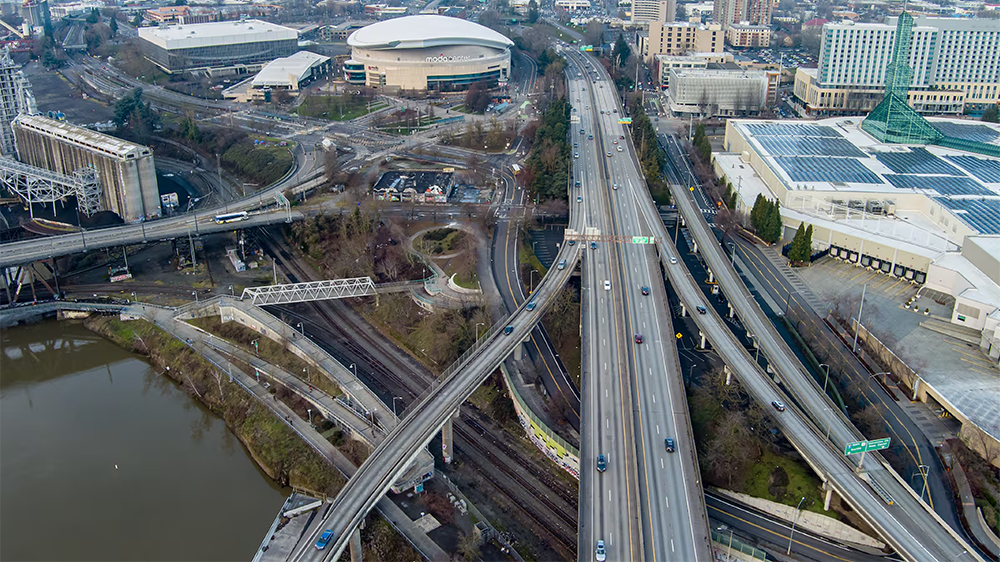

After a series of legislative failures, Oregon’s state transportation agency faces a financial crisis that could prompt a rethink of its approach. The situation offers lessons for the nation’s broken transportation program.
“She flies with her own wings.” That’s Oregon’s state motto, but right now her transportation program is looking more like an injured and grounded albatross. The Oregon Department of Transportation (ODOT) is saddled with hundreds of millions of dollars in debt and looking for places to cut spending so it can continue basic operations like plowing mountain roads and keeping up with landslides, washouts, and other critical roadwork. Oregon’s public transit agencies are also experiencing funding challenges and initiating service cuts across the state.
Origins of Oregon’s transportation funding crisis
While ODOT’s current financial crisis has been decades in the making, with many factors contributing, the state’s major transportation legislation passed in 2017 was a key moment. The Oregon legislature increased gas taxes and other motor-vehicle user fees but did not provide enough funding for the many large-scale highway projects it directed ODOT to deliver. Like many transportation agencies seeking legislation to advance expensive, complex projects, ODOT underestimated the costs, whether unintentionally or to make them seem more palatable. In addition, fuel efficiency improved, and Oregonians drove less than predicted even before the pandemic. This reduced gas tax revenue below 2017 projections. On top of all that, a congestion pricing proposal for Portland-area freeways—that would have generated additional funding—was scrapped.
Fast forward to 2025: the Oregon Legislature attempted to pass a comprehensive transportation bill that would have addressed some of ODOT’s funding challenges. It also would have shored up Oregon’s transit agencies, which, like many across the nation, face a fiscal cliff in the long hangover from the COVID pandemic. The legislature couldn’t get it done before Sine Die (the end of the legislative session). Instead, they reconvened in an emergency special session in September to pass a stopgap.
However, anti-tax activists quickly collected enough signatures to challenge the stopgap with a ballot measure this November, and polling suggests voters would kill the legislation. Having this referendum appear alongside high-profile elections for governor and key legislators on the November ballot could drag down support for Democrats and endanger their supermajorities in the legislature as well as the governor’s re-election. Democrats found they couldn’t legally repeal the bill, so they referred it to an earlier vote in May 2026 to get it over with. The referendum process forces Oregon to halt implementation of the stopgap bill, further exacerbating funding uncertainty.
Oregon at a crossroads
Oregon’s funding deficit is forcing hard decisions. ODOT and the Oregon Transportation Commission (OTC), which oversees it, must decide in consultation with the governor and the legislature what to cut to balance the budget. Several highway megaprojects are big budget line-items that have been untouchable in the past, but perhaps no longer.
The Interstate Bridge Replacement Project, a reincarnation of the failed Columbia River Crossing, is a massive bi-state freeway project that would replace the I-5 bridges over the Columbia River between Oregon and Washington with a larger bridge, expand the freeway spanning both states, and improve the transit connection between Vancouver, Washington, and Portland, Oregon. A FOIA request by local economist Joe Cortright revealed that the cost of the project had more than doubled from the 2023 estimate of $6 billion to $13.6 billion, and that project staff had hidden this information from decision-makers for months. With costs that high and the current financial situation, Oregon may no longer be able to commit to the project at its current scale.
The Rose Quarter I-5 project proposes to widen I-5 near downtown Portland and add freeway covers to help stitch together some of the Albina neighborhood, a historic black neighborhood that was broken up by eminent domain for the original construction of I-5, a sports arena, and a hospital. In a bid to have it both ways (freeway widening and caps) and have the feds help pay for it, ODOT applied for and won the largest federal Reconnecting Communities Program (RCP) funding award. But in a devastating blow to the project last year, the Trump administration rescinded most of this $450 million RCP grant. The Rose Quarter project was originally estimated to cost only $450 million in 2017, but the official current cost estimate has since crept up to around $2 billion. Last month, despite inadequate funding, the OTC directed ODOT to move forward with the project while balancing highway and community-based components of the original scope. It’s unclear how they can achieve this balance without adequate funding, given that freeway covers cannot be built before the highway is expanded.

To fill a $242 million budget gap, the governor has called for redirecting funding from the 2017 package, except transit funding, to basic road maintenance. It’s unclear whether the funding shift will be pulled from the megaprojects, safe routes to school funding, or funding allocated to counties and cities. The Street Trust, a local advocacy organization, is activating its members to protect Safe Routes to School (SRTS) funding that flows from the 2017 legislation. Many local entities, including every local jurisdiction in the Metropolitan Planning Organization for the Portland region supports protecting SRTS funding.
Oregon faces not only these funding decisions, but also a hiring decision. ODOT director Kris Strickler stepped down in January, creating an opportunity to hire either a change agent or a status quo actor. While the legislature has a lot of say in ODOT’s priorities, they also look to ODOT for information on costs and impacts of different investment decisions. A state agency that talks openly about the diminishing returns on highway expansion projects and the benefits of focusing on multimodalism and community needs could change the game, rebuild trust, and lay the groundwork for state investment in transportation.
Lessons for the nation
The federal transportation program isn’t a perfect parallel to the challenges in Oregon, but each situation could offer lessons to the other. The feds don’t choose projects. Instead, they pass out money while promising results in safety, congestion, and other outcomes. But just like Oregon promised a laundry list of projects they couldn’t deliver, the federal program is failing to deliver better results on just about every front.
Fiscally underwater, the federal Highway Trust Fund is going broke, and there has been no stomach for the kinds of tax increases required to bring funding in balance with spending. In fact, the gas tax was last increased in 1993. Transfers from the general fund totaling at least $280 billion since 2008 are the only thing that has kept it afloat.
But what if the federal program were re-oriented toward accountability and outcomes? T4A’s principles and reauthorization platform outline a pathway toward rebuilding the public’s trust in the federal program. The World Class American Transit report radically rethinks where we focus our investments in ways that can transform lives and communities.
In Oregon, the legislature could cut its unaffordable megaprojects loose and start focusing on the basics, like repair, safety, and connecting people to destinations. If they get back to basics and focus on results, they can win back Oregonians’ trust and more taxpayer dollars to fund transportation improvements. Let’s get this albatross off the ground and soaring with her own wings once again!
The post Oregon’s transportation funding challenges offer a lesson for the nation appeared first on Transportation For America.