


Finding and deciphering the lists of transportation projects planned by states and metropolitan planning organizations are nearly impossible for the average person. The plans they do have often involve making roads faster and more dangerous and the goals they have are divorced from a supposed priority of safety. These plans need to be transparent and easily understandable so that the public can understand how projects advance transportation priorities.
The U.S. provides billions of dollars in block grants to state departments of transportation and metropolitan planning organizations (MPO), but despite using public dollars, the projects seem unrelated to the USDOT’s “top priority” of safety. The DOTs and MPOs are allowed the freedom to allocate federal funding to projects they prioritize. They are required to document these projects, however in the end there is no real requirement to explain how these projects actually benefit the goals of the federal transportation program, namely safety. If we want to ensure that our program advances safety, we need to make sure that the entities receiving funding explain how their projects advance goals.
T4’s policy proposal for prioritizing safety over speed
In our second principle for reauthorization, Safety over Speed, we outline how to monitor how our states and MPOs are spending on safety:
- Require states and MPOs to detail in their core planning documents—State Transportation Improvement Programs (STIPs for states) and Transportation Improvement Programs (TIPs for metros)—their goals for safety and clearly explain how the projects they are choosing will advance those targets for safety.
- All approved STIPs and TIPs should be posted on the FHWA and FTA websites and be fully searchable.
- Update benefit-cost guidance to prevent transportation agencies from claiming safety benefits in congestion reduction projects without a study that shows congestion reduction will prevent crashes that result in fatalities and serious injuries for all road users.
State DOTs and MPOs receive billions in federal funding, and they are required to assemble lists showing the projects they will advance with those funds over the next four years. These required documents, known as Statewide Transportation Improvement Programs (STIP) and Transportation Improvement Programs (TIP), have to be updated at least every four years and explain which projects are being advanced by those federal dollars. The purpose of these documents is to explain how agencies are prioritizing projects and to help the public understand where their money is going and what it is expected to achieve. They fail miserably on all counts.
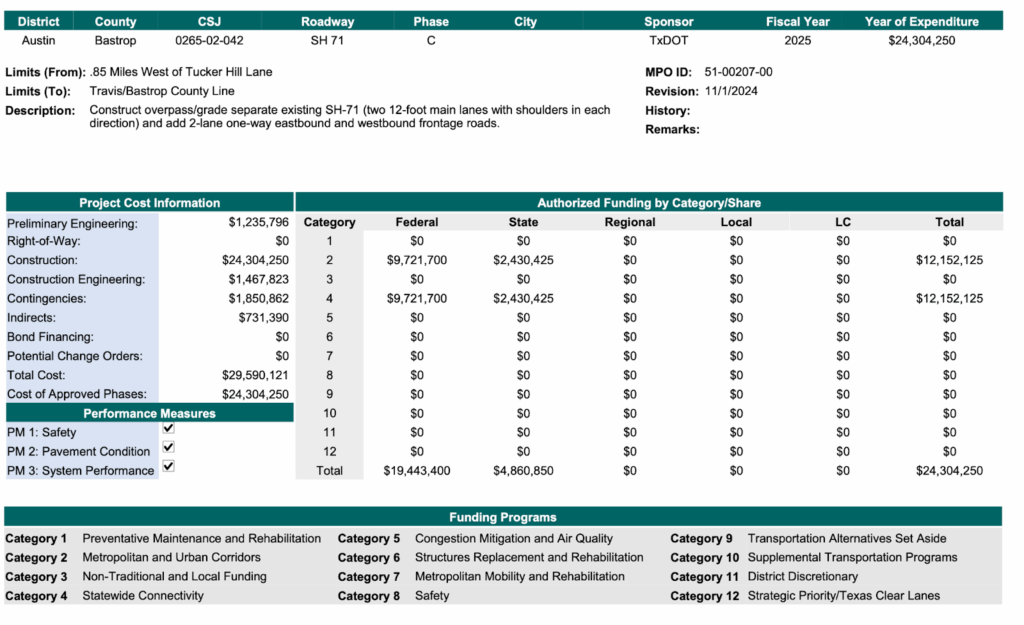
To understand a STIP/TIP, you first must try to find it. For a document that is supposed to inform the public, they can be extremely difficult to locate, and nearly impossible to decipher. Each state and MPO houses these documents differently. In some cases, these documents are not even posted publicly. Once you do find a STIP or TIP, it can be a mess to decipher. These documents vary wildly in how they explain information. Some are unsearchable, 100-plus page PDFs listing projects. Most lack any meaningful explanation of why the projects are prioritized.

Image from the Capital Area Metropolitan Planning Organization’s (Austin area) TIP that shows adding a lane will improve safety, pavement condition, and system performance.
Theoretically the projects that states or metro areas are choosing to include in these documents are supposed to improve transportation performance measures, including safety. That’s how the federal program was recalibrated back in 2012: States get lots of flexible money, but have to accomplish certain goals, like fewer roadway deaths.
But this is where this process breaks down: the process by which states and metro areas choose these projects with no real plan fails to connect to or advance any of their priorities To put it another way, a state may set a goal of reducing fatalities and injuries, and then pick a suite of projects to build over the next four years that have zero connection to actually accomplishing that goal. Afterwards, we’re all surprised when safety doesn’t improve or they miss their targets (or they hit their terrible targets).
Because the projects included in STIPs and TIPs receive federal funding, they need to be publicly available, searchable, and readable, so that taxpayers can understand both where their money is going, and what agencies are attempting to accomplish with it. Congress needs to direct USDOT to reform guidance on STIPs and TIPs so that they are housed in an easily-searchable, central database run by USDOT—all easily findable in one place. That means if someone is interested in how their state or MPO is spending money, they should be able to go to a centralized website, click on their state, and filter to find projects that are safety focused. When they explore a project, in addition to the typical information on funding sources and a general project overview, each entry should also include an explanation of how that project is going to improve the state of their system.
However, simply requiring explanations for the projects included in STIPs and TIPs won’t fix this issue. We need to change how states and metros justify their projects, especially around safety and repair. Oftentimes agencies will add a lane, claiming that it will improve the pavement condition of a roadway and improve safety. These justifications, the benefit-cost guidance, claim that congestion reduction will improve safety. In their eyes, creating less congestion creates fewer instances where cars will start and stop, leading to less minor crashes. However if congestion reduction actually reduces congestion (which is not a guarantee), it ends up speeding cars up. During the peak of the COVID-19 pandemic, less people drove, congestion was reduced, and speeds increased, and as a result our roads grew deadlier than ever. Safety is fundamentally incompatible with speed. Faster roads increase the likelihood of deadly crashes and create a hostile environment for pedestrians. We shouldn’t be funding safety programs that actually make it more dangerous for all road users, but our safety guidance values fast roads. To prevent transportation agencies from claiming safety benefits in congestion reduction projects, we need to require them to conduct a study that shows congestion reduction will prevent crashes that result in fatalities and serious injuries for all road users. We need to stop funding congestion reduction projects with grants that should advance safety.
Conclusion
Our transportation system is supposed to serve all road users, so why should we be targeting safety dollars to projects that do not prioritize that goal? In order to make safety our priority and to have real accountability, we need to ensure that states and MPOs are choosing projects that will measurably improve safety for all roadway users. That means clearly outlining what projects they’re working on and explaining how they advance safety. Without reforming the process by which STIPs and TIPs are created and shared with the public, it will be impossible to understand what our money is going towards.
The post Reforming state transportation plans to make safety the priority appeared first on Transportation For America.
