
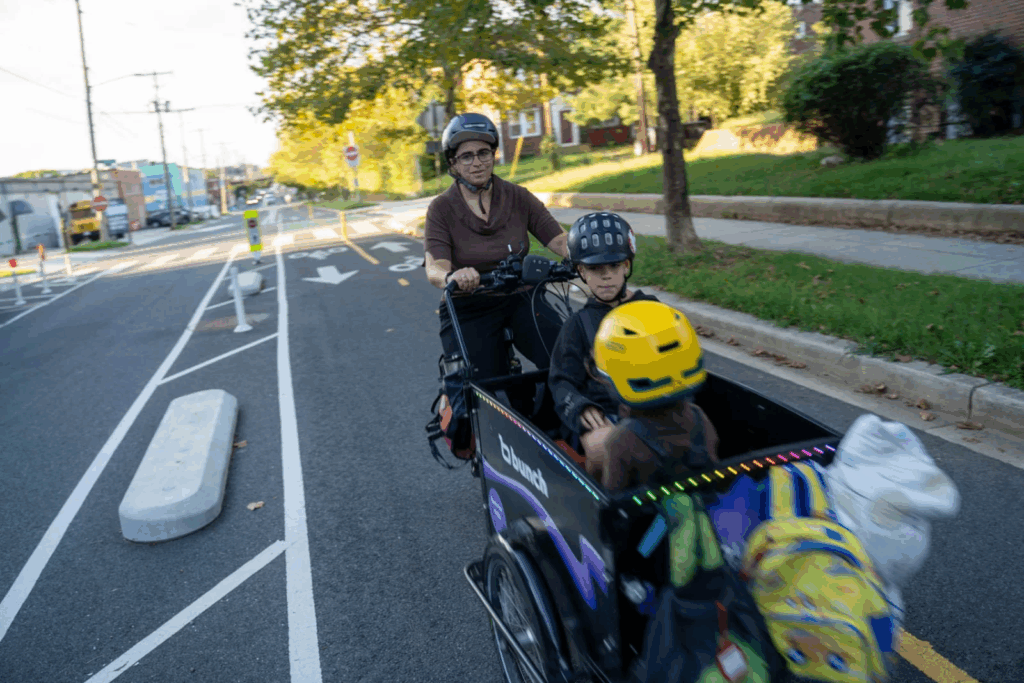

Owning and maintaining a car is expensive. Walking and biking are great options, but they can’t replace every trip. Cargo e-bikes can bridge the gap between the two, lowering transportation costs for families while making roads safer and more fun for everyone.
Owning a car and driving everywhere can break the bank. As new cars get more expensive and Americans continue to drive farther each year, the cost of car dependency will only increase. Although walking and biking are affordable options, they aren’t the answer for every trip. While we can and should better locate grocery stores and schools intermingled in our neighborhoods, that is not the case today. This can make long walks and rides with groceries or kids more difficult, especially for families.
With the spread of e-bikes (bikes with batteries that make pedaling easier), biking becomes more accessible to everyone. It also unlocks greater levels of mobility, as people can travel farther and more easily tackle hills that would otherwise leave them huffing, puffing, and sweaty. Cargo e-bikes can simplify small trips to the grocery store or after-school pick up. Suddenly, it’s not so hard to travel with your kids because of the pedal assist and cargo capacity. When most trips Americans take are less than 3 miles, and when 28 percent of trips are less than a mile, an SUV is overkill.
Demand for cargo e-bikes has been booming, with an estimated 4.2x growth over the next 10 years. Cargo e-bikes beat cars in affordability while also being safer for other roadway users. They can help people replace drives to the grocery store and get kids to school, all while decreasing wear and tear and congestion on our roadways. Cargo e-bikes can be the missing middle of transportation.
Affordability
Transportation is the second-largest cost for households, after housing. Cargo e-bikes are cheaper than cars and can reduce household transportation costs because of their lower upfront and lifetime costs. The median cost of a new cargo e-bike can range from $2,000 to $6,000.
This can seem expensive until you compare it with the price of owning and maintaining a car. In 2024, the average cost of a new car was over $50,000, and the average price of a used vehicle was over $25,000. In 2021, households spent $2,148 per year on gasoline, and auto repair and maintenance costs have increased 47% since 2020. Now, with lower fuel-efficiency standards, higher gas prices, more vehicle miles traveled, and increasing congestion, the crushing costs of car dependency will only get worse. Considering that 60% of U.S. households own two or more cars, replacing one vehicle with a cargo bike could literally save a household tens of thousands of dollars.
Living in Washington, DC, a lot of our daily needs are pretty easily reachable on foot (including our elementary school), we have good transit access, and our minivan fills in the rest of our trips. We’ve both ridden our bikes around town a lot, but as our family grew, we hit some limits. Rather than deciding to add a second car, we added electric bikes in 2019. My wife would pull one or two kids in a trailer behind her bike, and I bought a cargo bike that, for about 12 magical months, could accommodate all three of my kids at once. Other than the low cost compared to a second car, the best description of our e-bikes is that they unlocked the city—at a relatively low cost.
With even just one child in a seat on my analog bike, I always had to be mindful of how far we attempted to go, where the hills were, and what clothes I was wearing. But the cargo e-bike opened up a new level of freedom where we could just hit the road and go. During Covid, we would jet out aimlessly for weekend rides that ended up being 20 miles long without thinking about it. We would ride all the way down into Rock Creek Park to get deep into nature in those dark days, without worrying about how we were going to bike back up from the lowest elevation in the city. I could take the trailer to the grocery store and fill it up with groceries. We didn’t know if it would be a temporary experiment, but 7 years later, our e-bikes kept us from having to shell out the huge upfront expense of a second car, as well as the hassle of having to park and deal with its maintenance. E-bikes can’t fulfill every need, but at a relatively low price, we were surprised just how many trips we were able to replace with them. – Steve Davis, Interim Director, T4America
Family friendliness
For families with children, the savings from purchasing a cargo e-bike instead of a second or third vehicle are significant, and a cargo e-bike can replace the minivan for many trips. The percentage of kids getting dropped off at school in a car is now over 50 percent, and as parents deal with dreaded drop-off lines, cargo e-bikes are becoming an increasingly popular option for families.

Families benefit from the low maintenance costs and the freedom from the gas pump. In addition to the drives to school and soccer games, cargo e-bikes can also replace cars for grocery trips. Cargo e-bikes are great for moving goods for small trips, and in some places, they can even be rented to move furniture. Cargo e-bikes are also plain fun. Kids love seeing the world from outside a car, and nothing compares to the feeling of biking outside when the weather is nice.
Cargo e-bikes offer an attractive option for households who are feeling pressure from the costs of buying and maintaining a vehicle, and they can replace many car trips while lowering costs for families.
Safety
There are safety benefits for everyone from having more bikes on the road and fewer cars. Putting more cars on the roads—especially as they trend larger and heavier—will result in more injuries and deaths. SUVs are now the vehicle of choice for most Americans. While an SUV may be safer for those inside a vehicle, as cars get heavier and taller, the likelihood of getting killed by these vehicles increases. Americans are now driving bigger cars further, leading to hundreds of millions of dollars in medical care costs due to injuries caused by vehicles, killing more people, and tearing families apart. Adding more large cars to the road will only exacerbate the U.S.’s safety crisis.
Cargo e-bikes, on the other hand, do not pose the same danger that SUVs do. Ensuring that more people can use cargo e-bikes and encouraging their use means there will be fewer vehicles that pose a danger to other people on our roads. Shifting car trips to cargo e-bike trips could meaningfully make everyone’s experiences on the road safer.
Congestion
Roadway space is limited, and building more lanes will not solve congestion. Our roads need to move more people without adding more cars. A transportation system with public transit and walking and biking networks vastly outperforms dedicated car travel lanes at moving people. Because cargo e-bikes can feasibly replace car trips, providing dedicated infrastructure for bikes can ease traffic at a very low cost.

The congestion reductions from biking aren’t limited to commutes, and people take far more trips each day than just their commute. Cities such as New York City are working with e-commerce and shipping companies in order to replace some last-mile light freight trips with cargo e-bikes, and it’s working well. Instead of using box trucks or vans, the companies use modified cargo e-bikes to bring goods to people’s homes. They are larger than a typical e-bike, but smaller and lighter than a car, and are capped at 15 mph, which is safer for people walking and biking. They idle less, too, a win-win for both companies’ bottom lines and road users’ health. That means fewer large trucks clogging up roads, making everyone’s commutes safer and faster.
Plus, because cargo e-bikes weigh a lot less than an SUV, they cause less wear and tear on our roads. It would take 87 years for a cargo bike or 31,846 trips to do the same damage to the road that a small SUV does in one trip. That means fewer potholes and less money spent on repairing roads.

Cargo e-bikes are great at moving people and goods. They’re cheaper and safer than cars, too. If our transportation system is supposed to serve our needs and get us places safely and quickly, cargo e-bikes should be an integral part of a robust transportation system. As people use them more, local, state, and federal governments should look for more ways to support their use rather than discourage it.
The post Why cargo e-bikes are the missing middle of transportation appeared first on Transportation For America.