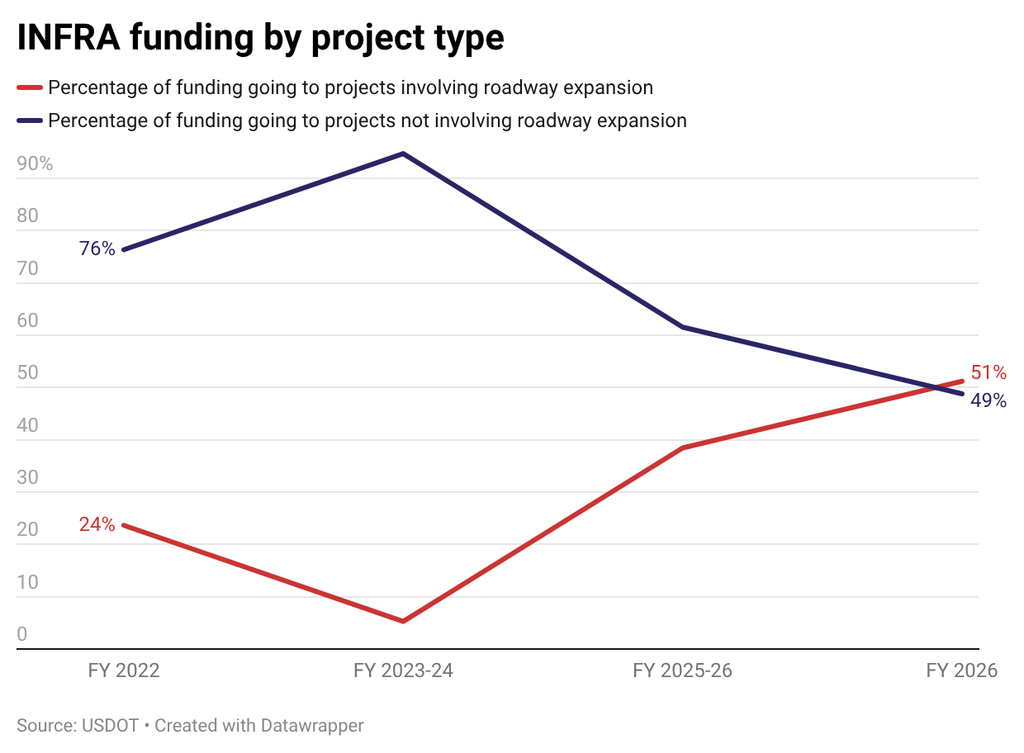

The U.S. Department of Transportation (USDOT) has signaled that one of its most important priorities for the next reauthorization is pouring billions into the interstate highway system like it’s 1955. What they aren’t prioritizing is a plan to pay for any of it.
Earlier this summer, Transportation Secretary Sean Duffy sent a letter to Congress outlining the administration’s priorities for the next federal transportation law due by September 30 this December. In that letter, under “Expanding and Modernizing Infrastructure,” Sec. Duffy asked Congress to create “a new competitive grant program targeted at expediting the completion and expansion of the Interstate system… The Administration’s objective is to launch completion of the Interstate Highway System, including the start of construction for unbuilt, congressionally designated highways.” (Emphasis ours.)
Even in a world of today’s uncreative thinking on transportation, this proposal is wildly out of sync with what people actually want and need from the federal transportation program, which is decidedly not “interstate system #1 was great, let’s run that back again!”
Here are five quick reasons this is a silly, counterproductive idea that would fit better in a black-and-white film strip from the 1950s:
- 1990s priorities are not what we should be pursuing in the 2030s
- The interstate system doesn’t need “completing” since it was finished in 1992
- We can’t afford to maintain the existing interstate system
- Every single potential highway project is already eligible for “completion” through federal highway formula funding programs—and states don’t have to compete for those
- Why spend billions more within a bankrupt federal transportation program?
1) 1990s priorities are just not worth pursuing in the 2030s
There are somewhere around 33 or 34 “priority” corridors identified by Congress—mostly in the 1990s and early 2000s—for potential addition to the interstate network. But these designations did not result from careful study or thoughtful growth projections. (If such a thing actually exists.) And they are certainly unhinged from today’s realities. Many were “designated” by members of Congress who are no longer even in office and possibly no longer even alive.
Here are some other things that were important to us in 1990: Getting an updated copy of the Yellow Pages. Choosing a movie to rent at Blockbuster. Worrying about the Soviet Union. Programming your VCR. Thinking about what to wear to hang out at the mall tonight. Wondering if your 32-volume encyclopedia is current. Wanting a new phone with a longer cord so you can talk in another room. Hoping the family computer was free. Waiting ’til tomorrow morning to read all the news in the paper.
Goodbye 1990s! Why should highway lines drawn on maps by members of Congress from that decade have any bearing on what we build to serve us in the 2030s, 2040s, 2050s, or beyond? I know the 1990s were pretty sweet for Secretary Duffy, but most Americans are thinking about tomorrow.
No one should ever forget that building the interstate system came at immense expense to certain people. The first part of our Divided by Design report explains how building the interstate system displaced more than 475,000 households and over a million people in less than two decades—most often in communities of color with lower incomes—and how today’s system hasn’t really changed and continues to inflict incredible damage.
2) The interstate system doesn’t need “completing” because it was finished in 1992
We actually completed the Interstate Highway System in 1992. Mission accomplished. Prep the ticker tape and start up the parade. There’s no reason to write a thousand words here—Chuck and Strong Towns wrote and released an entire report about it earlier this year.
The United States set out in 1956 to build a unified, high-speed, limited-access highway network that would connect the nation, strengthen defense, and support commerce. That mission was completed in 1992 with the final link of Interstate 70 through Glenwood Canyon. The Interstate era — one of the most ambitious and successful infrastructure projects in world history — achieved exactly what Congress and President Eisenhower envisioned: a national system that stitched together regions, opened new economic frontiers, and redefined American mobility.
Congress also acknowledged this fact in the 1991 and 1995 reauthorizations, by the way. 1991: “Congress declares that [these are] the final authorizations of appropriations and apportionments for completion of construction of such [sic] System.” 1995: “By 1991, that critically important mission—of connecting America and providing the core transportation infrastructure needed to sustain and promote interstate commerce and national economic prosperity—was largely accomplished.”
But the system hasn’t been in stasis. Even after its 1992 completion, states have continued to expand existing portions, build new segments, and convert existing highways into interstate-level roadways. The result is an interstate system that expanded from 200,000 in 1992 to more than 230,000 lane-miles today. Why? As the Strong Towns paper continues:
But instead of winding down a finished program, Congress left the machinery of that achievement running. A federal transportation system designed for a clear, finite purpose was gradually transformed into a sprawling, permanent institution, one that now continues spending not because of any remaining national mission, but because the system has come to depend on its own momentum.
How many more lane-miles do we actually need? More importantly, how many can we even afford to build?
3) We’re underwater on maintenance costs for what we’ve already built
Expanding the interstate system would create billions in new repair obligations. Every single new mile of road locks in decades of ongoing maintenance costs that can actually end up costing more than initial construction. A new program focused on expansion with zero plan for maintenance got us into this current mess. Read about the costs required just for ongoing maintenance in our Repair Priorities report from this year:
Maintaining the lane miles of roads that were in good and fair condition in 2024 would require an estimated $32.6 billion on average annually for routine preservation and maintenance. On top of that, addressing the existing backlog of roads in poor condition would cost an additional $10.6 billion per year over the course of a typical six-year federal transportation bill. In total, this amounts to $43.2 billion annually—more than $259 billion over six years—just to clear the backlog and keep the system in acceptable repair.
The $43.2 billion annual bill for basic state-of-repair road maintenance is more than what the gas tax brings in each year. (~$35-39 billion.) And that number doesn’t even include what’s needed for the 624,000-plus bridges eligible for federal dollars. No rational person would consider expanding a system that our current funding source cannot sufficiently pay to maintain—even if we devoted every single dollar of existing revenues to that purpose.
4) Every single possible zombie interstate expansion project can receive federal funding right now
A new grant program for “completing” interstates is unnecessary and redundant. Every possible interstate or highway expansion project is already eligible for nearly every single federal highway funding program.
Does the North Carolina DOT want to “expedite” construction of its long-gestating Interstate 87 project to connect Raleigh’s Interstate 540 bypass east all the way to Interstate 95? Just put it on your five-year project list and start giving it some of the $1.3 billion in federal highway funding you received in FY27. States don’t even have to compete for those funds—they’re already in their wallet!
If these projects haven’t been built yet, maybe they’re not that important to the states making these decisions? If states don’t deem them important enough to use their highly flexible federal dollars on them, why should USDOT create some new program for the same purpose? And why should any of us (or our grandkids) pay for it?
Creating a new grant program for this purpose is like your kid, who has a weekly allowance they can spend on anything they want, asking for a special new allotment to buy candy at the corner store. “Just open your wallet and use the money I gave you, if that’s what’s important to you. And before you ask, no, there is no more extra money.”
Because…
5) The federal transportation program is bankrupt
The current program is bankrupt, and has been for nearly two decades.
As noted above, Congress has spent more each year than the gas tax brings in, creating a long-term insolvency problem and forcing all taxpayers to bail out a program that was supposed to be fully covered by a user-pays trust fund. Drive your car and buy gas, pay into a system of roads built with those taxes. But that fundamental tenet of the program hasn’t been true since at least 2008.
Where is the money coming from for a new competitive grant program to advance insanely expensive interstate projects that have been on the books but unbuilt for 20 to 30 years? Of course, USDOT isn’t proposing any particular funding source for this new program—that’s Congress’ problem. Which means it’s really your problem, because you (and all taxpayers) have helped foot the bill for the $275 billion in deficit spending on the current program so far. So dig deep once again, folks, as Congress passes the hat.
—
Back in 1991, the average price of gas was about $1.15 per gallon. General Motors hadn’t yet built and then killed the first production electric car. The median price of a home was $120,000. Since then, the ratio of home prices to median incomes has increased 25 percent.
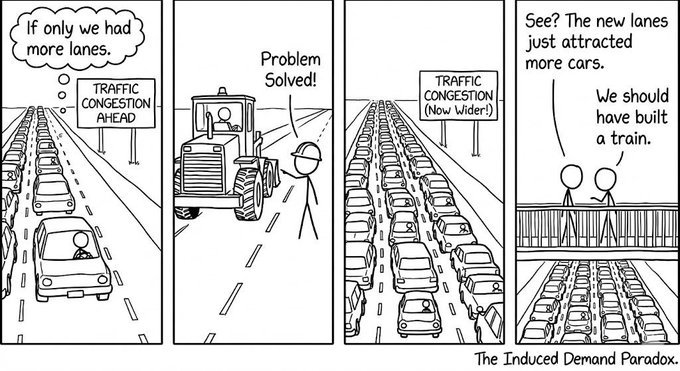
We need new homes, not new highways. We can’t afford to keep chasing the marginal, diminishing economic returns of a new lane here or there on existing highways, and we certainly can’t afford the repair bill on a dramatically expanded system. As Chuck so eloquently said in Mission Accomplished, “It is time to declare the original mission accomplished, acknowledge the program’s drift, and rebuild the federal transportation role around the needs of the 21st century rather than the habits of the 20th.”
After prioritizing repair, it’s time to “invest in the rest” and build a complete transportation network that focuses on moving people and goods—not just vehicles—and building productive, resilient places full of opportunity.
And we don’t need a new grant program to do any of that. Spend what’s in your wallet, son.
The post The interstate system was completed in 1992, but USDOT wants to pour billions of your dollars into “completing” it again appeared first on Transportation For America.